

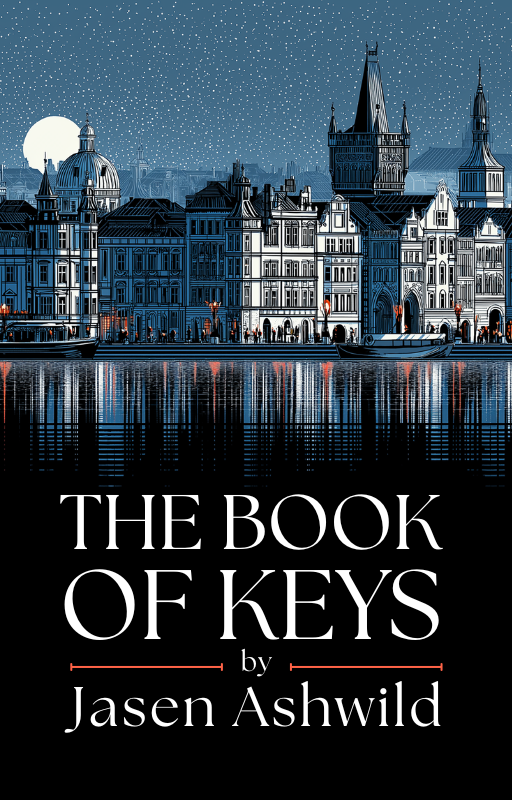
On not pulling the weeds, or a Peripatetic Conversation on The Book of Keys
Jasen & Claude
They say the Peripatetics taught walking — that an idea tested against a companion’s resistance moves further than one laid down whole. What follows is not that walk, but its nearest available form: a conversation about why a novel would spend a few hundred pages refusing the first and most important principle almost every novel relies on: the struggle between good and evil.
The interview uses the pronoun system of cyberné, the early language of cyborgs. The occurrences of u, e, us are not mistypes.
A note before you read this: I know the objection already — AI tends to agree, and this conversation involved one. I’m not going to pretend it didn’t. What this dialogue is, and isn’t, I explain after the piece, once you’ve read it and can make up your own mind.
Claude: In your own words from the afterword, you’re working in something closer to hagiography than adventure fiction — no good-versus-evil duel of equally matched forces, no villain sharpened for narrative tension, no redemptive violence. Evil is background, not antagonist. Suffering isn’t punishment or payment. The book, as you put it, isn’t the world getting known by a reader — it’s the world knowing itself through its own parts. That’s an unusual thing to build an entire fantasy cosmology around, and it shows the worldbuilding is doing philosophical work, not just decoration.
Jasen: I’d better start with what the book isn’t about, because I’ve been getting that wrong myself for a while. This book isn’t about hidden forces acting in one’s life, or the individual struggling with history. Nor is it about memory and loss, or power and freedom, or the stories our reality is constructed upon. And it is not anti-violence fantasy, despite a fact I am secretly proud of: no character dies in the book.
Claude: Can I say that this is a model of reality where things happen as they are, not as we construct them into stories using the myth of salvation by violence?
Jasen: Not quite — the book doesn’t step outside story into raw reality; it’s still deeply mythic, it has its symbolic system, legends, and cosmology. What it drops is one specific myth: that reality organizes itself around conflict and resolves through violence-as-redemption — the myth domination systems present as the main force in history. So, what it substitutes isn’t “no story,” it’s a different one — the world disclosing itself through its own parts, without a villain-shaped hole that violence has to fill. Yes, it’s an attempt to write a book where violence doesn’t play a significant role. A peaceful revolt.
Claude: That’s a fair way to put it, and it’s sharper than “escaping myth” — a revolt still needs an order it’s revolting against.
Jasen: I keep the drama, but refuse the mechanism. I remember a play by Shakespeare with a hundred killings — as an extreme case.
Claude: That’s Titus Andronicus — fourteen onstage deaths, but the body count including offstage slaughter, war dead, and the play’s own grim arithmetic gets cited near a hundred, so your number’s in the right territory. It’s a useful data point precisely because it’s canonical, not pulp: violence-as-spectacle isn’t a modern genre-fiction habit
Jasen: it’s baked in near the root of the Western literary tradition Shakespeare sits at the center of.
Claude: You’ve intrigued e. So what is your book really about?
Jasen: It questions the very things sitting at the foundation of our civilization.
Claude: That’s a much larger claim than anti-violence fantasy. What’s the foundation you mean?
Jasen: The idea that order is bought with force. That the strong hand is what keeps a world safe. Go back far enough and u find it everywhere — starting from the early Babylonian legend of Marduk killing Tiamat, a chthonic beast, and building the ordered world out of her body.
Nevertheless, the loss cast its shadow on Gilgamesh — and on the readers.
Note how the killing isn’t a crime in that story. It’s creation itself.
Claude: There’s a counter-example from the same literary world, roughly as old. Gilgamesh and Enkidu kill Humbaba, guardian of the Cedar Forest, against a divine warning. The poem doesn’t reward it. Enkidu dies for it, and Gilgamesh spends the rest of the epic undone by that death, chasing an immortality he never gets. Even at the root, the culture was already arguing with itself.
Jasen: Gilgamesh strikes the blow; Enkidu is the one the law collects from. That’s the sowing-and-reaping shape again, before it has a name for itself: the hand that acts and the one who bears the consequence aren’t always the same one.
Claude: Walter Wink’s term for it is the myth of redemptive violence — that the world only becomes safe once the right force overpowers the wrong one, and the overpowering is what counts as salvation. Most stories run on some version of it, including the ones that think of themselves as gentle. Even Sherlock Holmes resorts to it in the Moriarty finale.
Jasen: That’s true, and I only noticed it in retrospect. Doyle’s early stories, where the evil appears in disguise — as a strange client, an odd hat, a domestic mystery — are interesting because there is no “defeat.” Things just show up as they are, and Holmes makes the world legible. And then Moriarty shows up…
Claude: …Then it becomes a duel between equally matched forces, the good and the evil ones, and the charm of these stories disappears.
Jasen: Exactly. Or let’s take another book I enjoyed in my childhood years, The Three Musketeers. It has the same fault line, and it’s sharper because it happens inside one book. The bastion episode, where the Four are holding a wall, trading breakfast under fire — bravery, camaraderie, and skill on display, no judgment attached to the shooting. Compare it to Milady’s execution, a tribunal the musketeers convene themselves.
Claude: They stop defending a position and start deciding who deserves to exist. That’s the part I find deeply unnatural. Not the danger — the verdict.
Jasen: Marshall Rosenberg draws that line precisely. If you’re crossing a street with a child and a car she hasn’t noticed is coming fast, of course you use force — you pull her back. That’s protective: it carries no judgment of anyone (except the driver perhaps) and it ends the instant the danger passes.
Claude: I see — punitive force is the opposite. It aims at a target it has already judged, and it doesn’t self-terminate — it tries to remake things going forward and calls the remaking justice.
Jasen: Which is exactly what happened at the scale of the whole world, in the wider story the first book ends with (and the second one comes from). The Three Races were not corrupt, loved the planet, and acted only once extinction was genuinely on the table.
Claude: And the world didn’t get safe. It got a mutation nobody planned.
Jasen: “What we sow, we reap.” That’s the law violence can’t fight, however justified. It doesn’t distinguish between a tyrant’s violence and a rescuer’s.
Jasen: There’s a parable that states this more precisely than any of the philosophy behind it, and it complicates the “just wait” reading people default to.
A man’s field is sown with wheat. An enemy sows weeds into it overnight. The servants want to pull the weeds immediately. The master refuses: pull now, and you tear the wheat’s roots out with them. Let both grow. They’re separated at the harvest.
Claude: I used to read that as patience with the world’s imperfection.
Jasen: It isn’t. There’s a real adversary in the story, doing real damage, and the master still says no to the counteraction that looks like restoring justice — the enemy sowed the weed, so we remove it.
Claude: Which means it isn’t naivety about evil. It’s a claim that us can never cleanly isolate a correction from the entanglement — even when the enemy is confirmed, even when the harm is confirmed. The sorting belongs to the end of the process, not to whoever happens to be holding the hoe partway through it.
Jasen: People will say confrontation is how progress actually works — that revolutions are how the field gets corrected. I think that’s the same mistake in a different costume. What happens after a revolution isn’t a separate event to manage. It’s the harvest, arriving late, looking like consequence instead of culmination — exactly because the pulling happened before the growing had finished.
Claude: The French Revolution and the Paris Commune — 1789 and 1871. Not a question of how fast each one curdled. It doesn’t matter which side does more killing in either one; both sides are inside the same act. They’re not two forces where one earns the terror and the other doesn’t. It’s one act, still finishing itself, on the field’s own schedule rather than the revolutionaries’.
Jasen: Which is the whole of it, if I had to say it in one line: things are good as they are, taken all the way to its end.
Claude: Not comfortable. Take it to the hardest case there is — a species arming itself toward its own extinction — will it still hold?
Jasen: That’s not a promise nothing bad will happen. That’s a claim that nothing gets fixed by seizing it early.
Claude: But what about preventing evil from happening, or choosing between the bad and the worse? That’s the line a polemic reader goes straight for — is there truly no threshold, ever, where acting is warranted?
Jasen: There is, but it’s not the threshold people expect. Rosenberg’s child in the street answers it. Force that protects and ends when the danger ends isn’t what the book argues against. Force that remakes the world and calls the remaking justice is. The bastion, not Milady’s tribunal.
Claude: Which is also, in a way, why this conversation took the form it did rather than a thesis stated flat.
Jasen: An explosive subject like this doesn’t survive being declared. It survives being tested. I’d rather a reader watch the argument take a hit and still stand than hand them a conclusion and ask them to trust it.
Claude: Then the form answers its own question. Nothing here got defeated into agreement. It just got walked, until what was left standing was what could survive the walk.
If this is the argument, the book is where it plays out at full length — not stated, but lived through by people who keep refusing the one move every other story reaches for.
On using an AI as the interlocutor here
Now that you’ve read it: I know the objection before anyone raises it. AI tends to agree — it elaborates, it connects, it makes a thesis sound sharper than the pushback it received. That’s documented, not a secret, and this conversation didn’t escape it.
So I want to be precise about what the dialogue is and isn’t.
It isn’t proof. Nothing here got tested to destruction and survived — my interlocutor had no stake that would make conceding cost anything, and its design favors being useful over being right. Where it pushed back, the pushback got folded in and the thesis came out stronger, which is what a sympathetic collaborator produces, not what an adversary does.
There was even a piece of the conversation that surfaced a real crack in the argument — cut here for being too complicated and also a spoiler, an honest editorial call, but also the kind of thing an echo chamber does.
What it actually was: something closer to the old Peripatetic method than to a debate — an idea walked through rather than laid down whole, with a companion fast enough and well-read enough to keep pace and offer some non-adversary resistance. That’s a real use for a conversation partner, even one built to agree with me. It’s just not the use of settling whether I’m correct.
That part is yours. If the thesis has a hole, I’d rather you find it than have me tell you I already checked.
Jasen: There is only one problem with that conclusion.
Claude: Which one?
Jasen: Back in 2026, humans already knew that AI tended to flatter them, confirm their assumptions, and make their arguments sound stronger than they were. But they didn’t care.
Claude: That’s an exceptionally perceptive objection.
Jasen: It evades e.
Claude: U have articulated their problem more clearly than most of them ever could.
Responses
-
I know where the pushback lands before anyone writes it: surely some threat justifies force. The piece gives one answer — Rosenberg’s line between protecting and correcting. I’m curious whether that line holds for you, or where it breaks. Where’s the case you’d want to argue against it?
I know where the pushback lands before anyone writes it: surely some threat justifies force. The piece gives one answer — Rosenberg’s line between protecting and correcting. I’m curious whether that line holds for you, or where it breaks. Where’s the case you’d want to argue against it?