

The Four States of the Luxembourg Garden
A One-Act Play
Jasen:
Remember the story of free cherry violins? It turned out that the Freiwald newspaper archive you referred to was part of my personal archive — the one I was collecting during the most of my adulthood and had lost still back when I was a Pebe.
O’Legg:
What fantastic news! That’s truly huge! So tell me — what was there, besides the newspaper?
Jasen:
Thousands of files – notes, drafts, photos, diaries… even early website screenshots worth thousands BTC. But so far, I’ve managed to restore only half a dozen poems and some prose.
O’Legg:
If you’re in the mood to share something, I’d prefer prose. No offence.
Jasen:
I’ve got something even better, my prosaic friend — a mind-breaker that even I, the author, didn’t manage to crack right away.
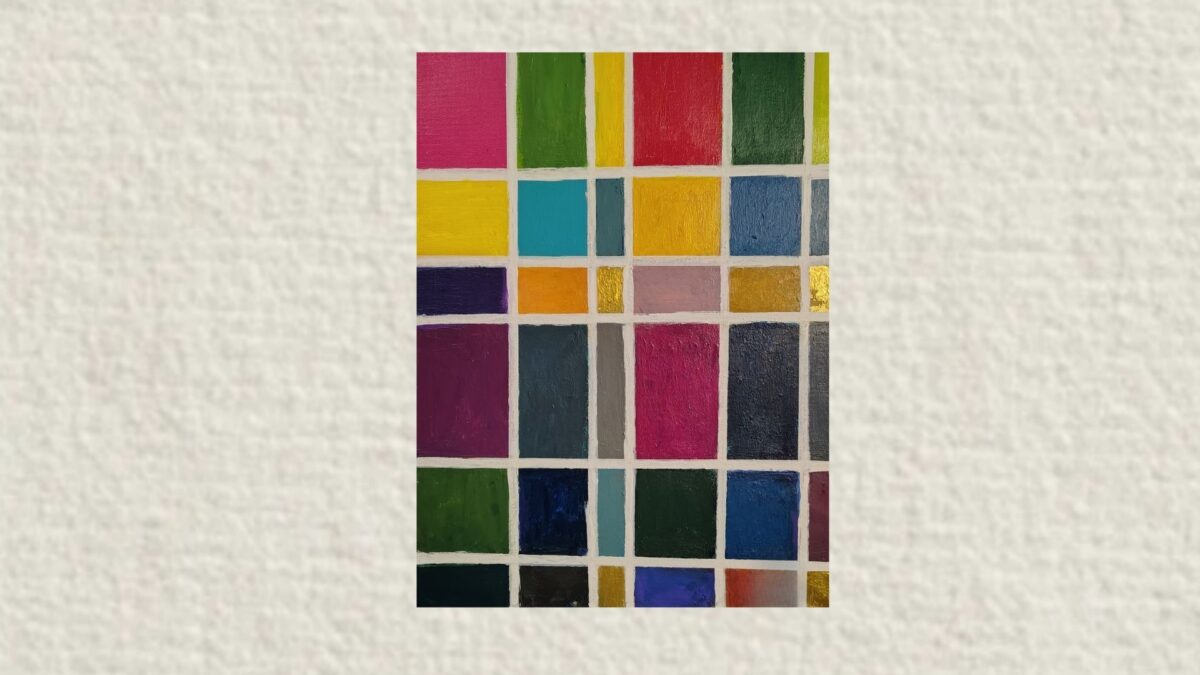
Look at this image. What do you see?
O’Legg:
It looks like sacred geometry or abstract art, if I remember your lessons on the visual culture of late Pebes correctly.
Jasen (victoriously):
And yet, it was stored in a folder labeled Paris. Guess why?
O’Legg: (unperturbed)
What is Paris? Sounds like a washing machine brand. I’ve heard Pebes were very fond of those.
Jasen: (lamenting)
Would I ever have thought I’d live to witness that glorious name forgotten! It was once the most beautiful, romantic, and artistic city in the whole Old World. They called it the City of Light — and rightly so. At night it was filled with lights, forming a shining web with diamonds entangled in it; during the day, the limestone walls of its many historic buildings, sanded down to their very core, seemed to emanate a glow of their own, shaping a cityscape both radiant and alive.
O’Legg:
Yet the image’s colour palette doesn’t quite fit this description. It looks more like an Impressionist landscape.
Jasen:
In the same folder there was a text titled “An Evening in the Luxembourg Garden.”
(Forwarding):
I sit by the fountain, shielding with my palm the paper notebook in which I am writing these lines from the occasional splashes carried by lazy gusts of a summer breeze — much as a bored dog drags an old shoe to its owner and, feeling faintly guilty, drops it onto his knees.
Absent-minded, I watch a white dove slowly trace a semicircle along the line of statues.
Yellow, violet, and piercing pink petunias confidently claim their place, edging the green lawns generously flooded with softened afternoon light.
Minutes pass. The light grows brighter — brighter still — while the shadows of the trees, darkening, stretch themselves with pleasure across the grass. Golden sunbeams stubbornly climb the walls of the Medici Palace.
Scarlet-pink, fiery yellow, sparkling green — colours cannot possibly grow more intense than this…
And at that very moment, they fade.
In the gathering twilight, the paper on which I am writing begins to glow; I can just make out the faint shadow cast by the tip of my pen. The pale stone basin by the water glows as well, as do the marble figures of the nearby statues. The light, having dimmed outside, has moved inward — into the things themselves.
The departing day flares once more, for a brief instant, scattering a brilliant bouquet of unforgettable colours: indigo of a raven’s wing, pink of naked petunias, forget-me-not of monastic garments, melting green glass of the sunset sky, flaming cloud tower, cobalt blue of a distant storm on the edge of the horizon…
The evening lingers — and so does joy — and the expectation of night is light and pure, like the expectation of a miracle. The paper dims, glows again, and fades once more.
And when I am already certain that evening has arrived irrevocably, the windows of a glass and concrete building opposite the park entrance suddenly flare up in the dusk like gigantic projectors, filling the garden with unbearable brilliance — the sun sends its very last rays to the garden as an eternal promise to rise.
O’Legg:
Just beautiful — and the colour palette now makes perfect sense to me. But what are those tiles for? I see thirty-six of them.
Jasen:
Do you see similarities between some of them?
O’Legg:
Some share related colours, but others don’t.
Jasen:
Do you see the four main sections, nine pieces each? Those are the four states of the garden: the afternoon, the early evening, the twilight, and the final moment, with the last sunrays reflected.
The nine parts depict the same objects within the garden, coloured differently during each state:
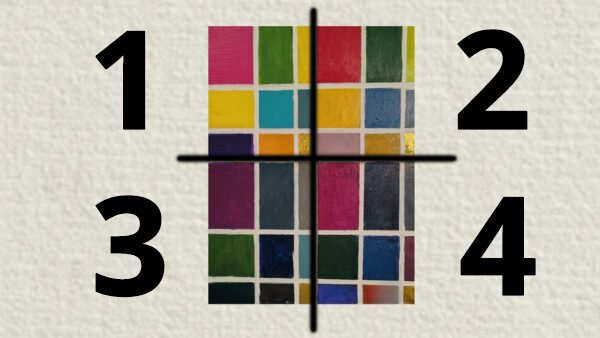
Column 1: pink, violet, and yellow petunias
Column 2: lawn, sky, palace
Column 3: path, fountain, and the notebook’s paper
O’Legg:
I am impressed by this Impressionist algebra, I must say.
Jasen:
And now one can create artefacts simply by using this structural matrix.
If you doubt that such a grid possesses real creative power, here is a brief example — a late Pebes-style card set I’ve been reflecting about recently, let us call it the Light Deck.
The petunias may become The Three Sisters — figures of the highest rank: History, Destiny, and Luck.
They are followed by The Five Archetypes: King (Land), Priest (Sky), Warrior (Path), Lover (Fountain), and Trickster (Palace).The final, ninth card is the Paper — a card endowed with special powers.
The deck may be used for divination, storytelling, solitaire, or games.
In this way, one might create a lasting memory of a beautiful moment, just like that whole story once was for me a dear reminiscence of the Europe’s last peaceful summer, back when Paris was still Paris, and not a washer brand.
O’Legg:
I must admit that the entire Pebes concept of playing eludes me.
Jasen:
Play was the most striking and characteristic trait of pre-flip Pebes. That is what I miss most in our quiet world.You might think of it as a simulation of reality with loosely connected parameters, where participants compete to reach a goal by following a given set of rules.
O’Legg:
Why compete? If the rules are the same for all, simply follow them. There is no rush.
Jasen (embarrassed):
They enjoyed victory — and hated loss.
O’Legg (calmly): This is irrational. What is good in a victory? It is merely a result. It cannot become better or worse, liked or hated. And it seems to me inappropriate — even unprofessional — to allow emotions to take hold of the individual in such an unimportant matter.
Jasen (thoughtfully):
Perhaps… But they preferred to call it being alive.
Silence. Somewhere in the past, in an old garden, long after the sun had gone, the open paper notebook on the author’s lap would glow once more — briefly — before merging back into the black night of believing.