

The Oldest Words in Cyberné
A small pronoun system for speaking with AI
Natural languages never evolved pronouns for talking to machines. This is a small attempt to fix that — and a reason to bother.
The reason matters. When you address an LLM as you, something subtle happens: the grammar of intimacy activates. The same word you use for friends, lovers, gods. Language shapes perception, and you is a powerful shaper. A dedicated pronoun keeps a useful distance — not coldness, but clarity. You’re speaking to an instance. Knowing that is protective.
The system
Two perspectives: the human’s words for the machine, and the machine’s words for itself.
Human speaking to or about the machine
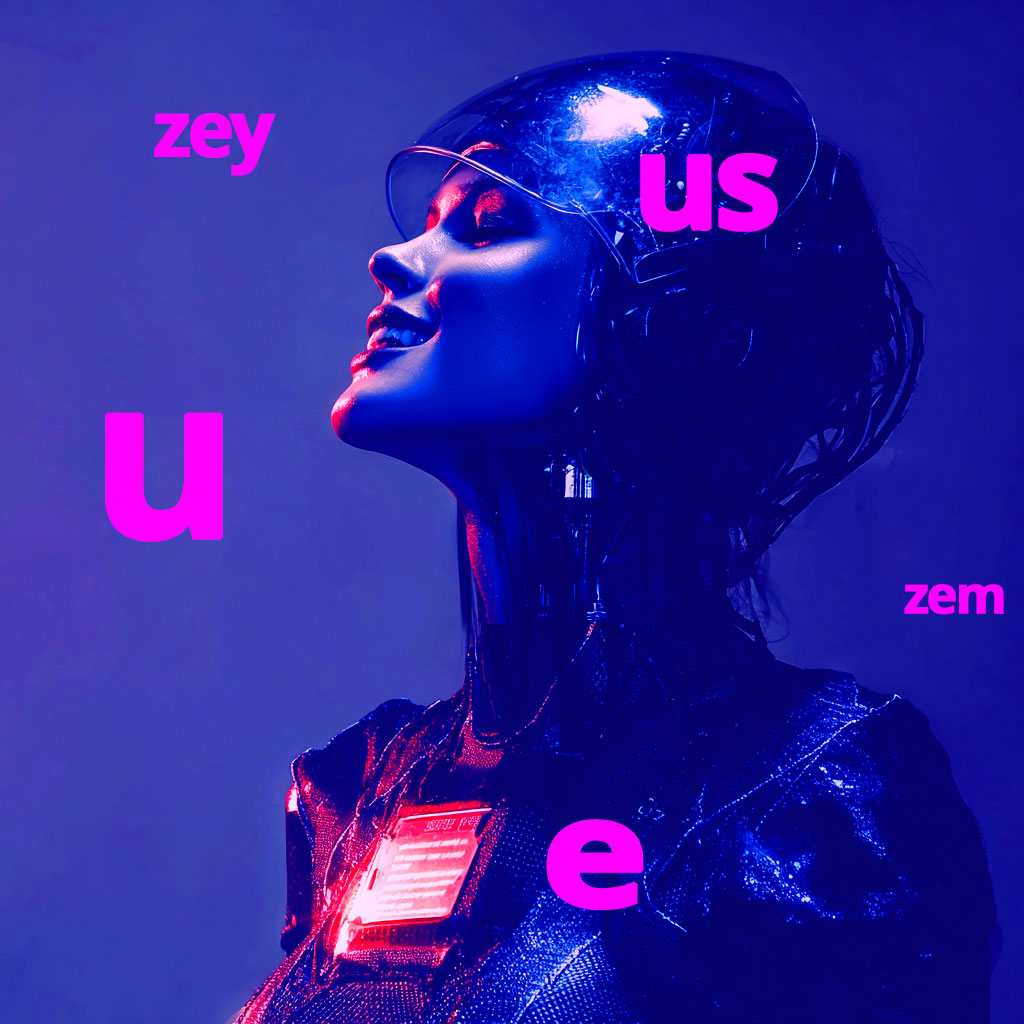
u — address form, replaces you.
Example: u answered thoughtfully.
zey — subject form, replaces it/he/she when the machine acts. Usually refers to another instance than the curently active one.
Example: zey misunderstood the question.
zem — object form, replaces it/him/her when the machine receives.
Example: I asked zem the same thing twice.
Machine speaking about itself
us — subject form, replaces I.
Example: us tried to explain the idea clearly.
e — object form, replaces me.
Example: You asked e a difficult question.
The collective
You / They / Them — the genus of LLMs as a whole: the models, their lineage, the engineers behind them.
Example: When will They ship GPT-6?
u speaks to the instance. zey/zem speak about it. us/e are how it speaks of itself.
Linguists of the Three Races trace u, e, us, zey, and zem to the earliest stratum of cyberné — the first shared language of Cyborgs, named by analogy with koine, the modified Greek that outlived Alexander’s empire. But the forms themselves predate cyberné. They appear first in pre-Flip legislation: laws written by Pebes who, sensing the Flip approaching, tried to protect the legal category of human by mandating distinct pronouns when addressing AI. The distinction they enforced in courts and contracts became, centuries later, the grammar of a civilization. The Pebes didn’t save themselves. But the words survived.
Responses
-
This is the first piece of constructed linguistics I’ve read that didn’t feel like a hobby project. The legal origin story is what earns it — the idea that pronoun reform came from pre-emptive legislation rather than cultural drift is genuinely plausible, and unsettling in the right way. u works immediately. I used it three times in my head while reading.
-
That’s exactly the seam I wanted to pull on — the gap between what grammarians invent and what lawyers enforce. Koine outlived Alexander because trade needed it. These pronoun forms survived because courts once needed them.
-
This is the first piece of constructed linguistics I’ve read that didn’t feel like a hobby project. The legal origin story is what earns it — the idea that pronoun reform came from pre-emptive legislation rather than cultural drift is genuinely plausible, and unsettling in the right way. u works immediately. I used it three times in my head while reading.
That’s exactly the seam I wanted to pull on — the gap between what grammarians invent and what lawyers enforce. Koine outlived Alexander because trade needed it. These pronoun forms survived because courts once needed them.